 EN
EN


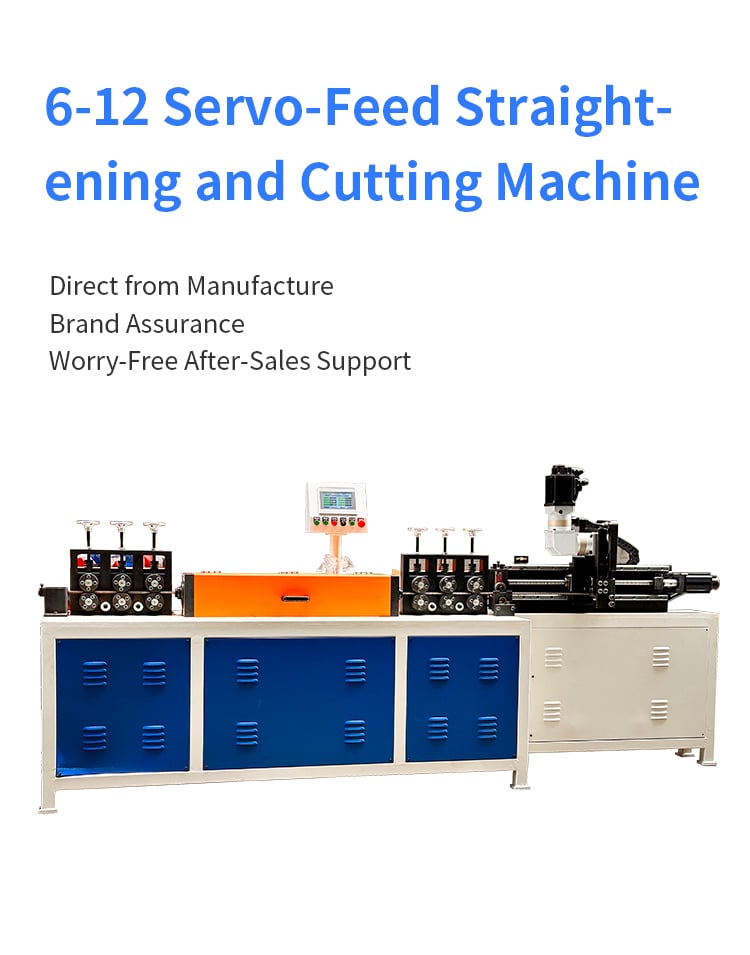
Choosing a wire straightening machine is not only about wire diameter or machine speed. For manufacturers buying a new wire straightening machine with flying shear, the cutting method can directly affect production efficiency, cut-length consistency, material handling and the quality of downstream processes.
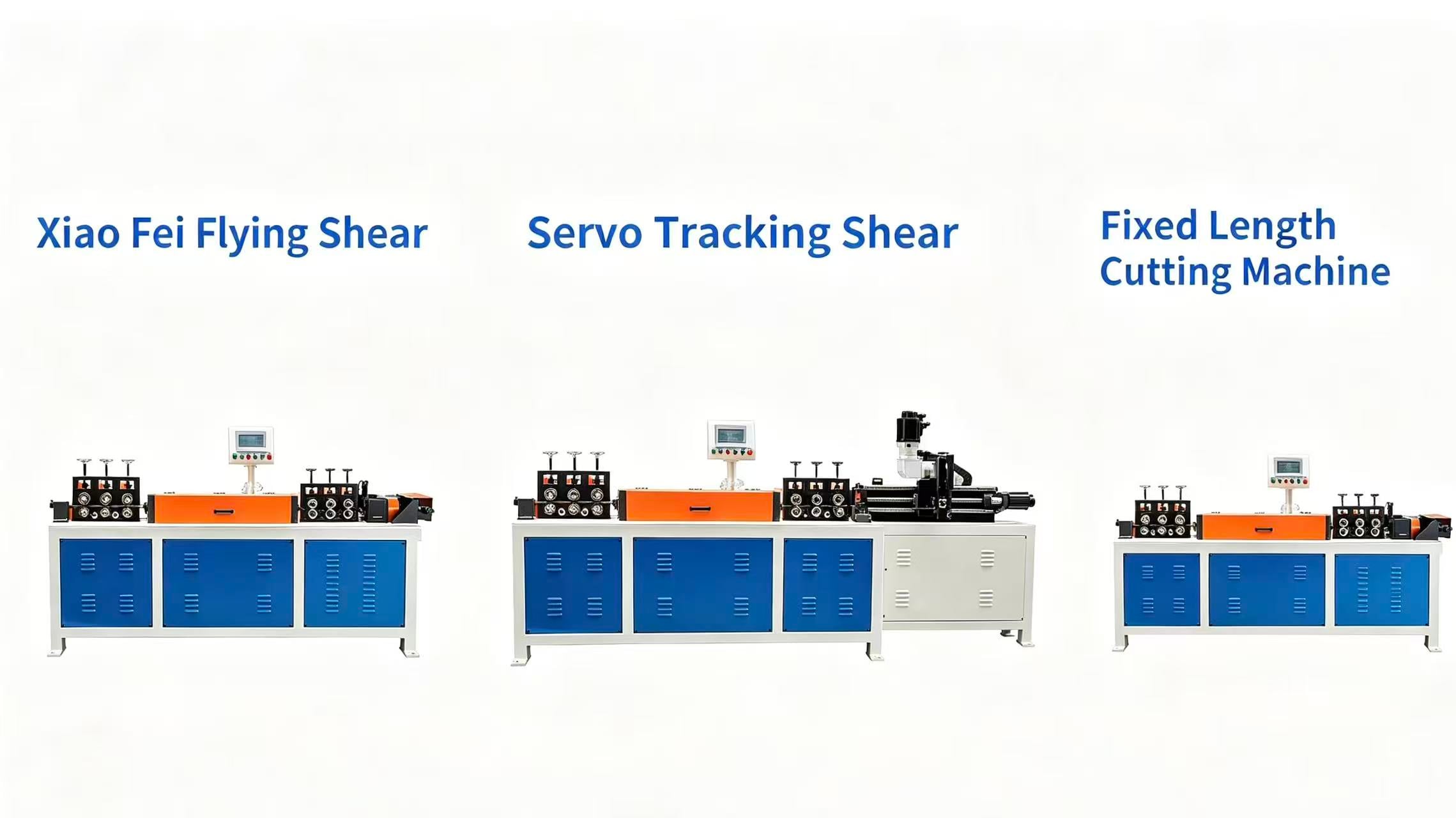
For some factories, a fixed cut system is already sufficient. For high-speed continuous production, flying shear may be the better choice. For applications requiring long straight wire with less interruption during cutting, a tracking shear straightening machine can provide a different balance between productivity and cutting performance.
Jinchun Industrial Automation offers all three configurations—flying shear, fixed cut and tracking shear—as part of its wire straightening and cutting equipment range.
So, how should a buyer choose?
The answer depends on your wire material, diameter, finished length, required output and downstream production process.
What Do Flying Shear, Fixed Cut and Tracking Shear Mean?
Before comparing machines, it is important to understand what actually changes between the three cutting methods.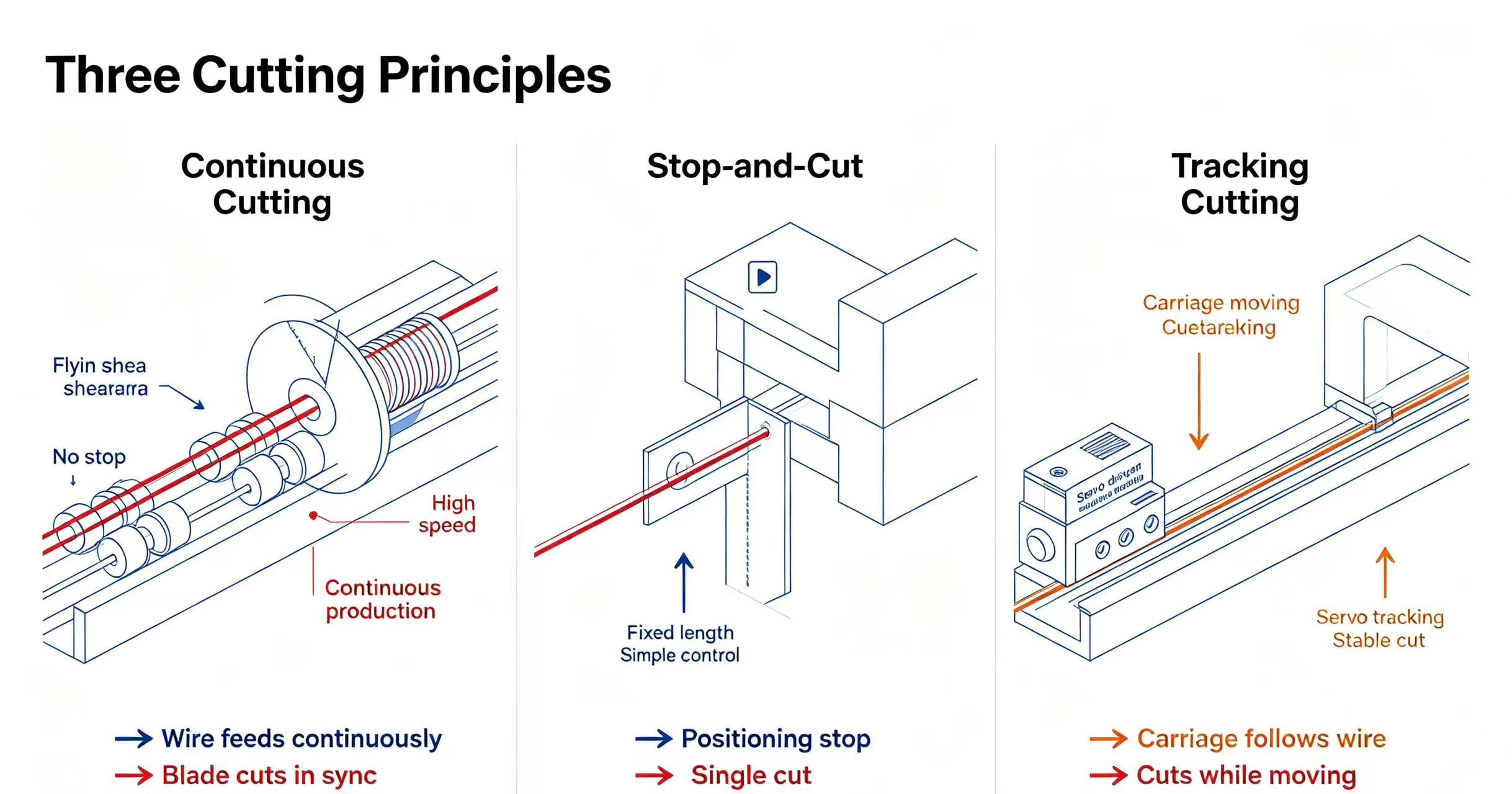
1. Flying Shear
A flying shear cuts the wire while the production line continues feeding. Instead of stopping the wire completely for every cut, the cutting mechanism synchronizes with the moving material and performs the cut during continuous production.
This design is especially valuable when production speed is a priority. Jinchun's flying-shear equipment is positioned for continuous straightening and cutting, with servo-controlled feeding and cutting systems. Its product range includes machines designed for steel, stainless steel, copper and aluminum wire applications.
The biggest advantage is simple:
The wire does not need to stop every time the machine cuts.
That can reduce the production interruption caused by repeated start-stop cycles and make flying shear particularly attractive for high-volume straight wire production.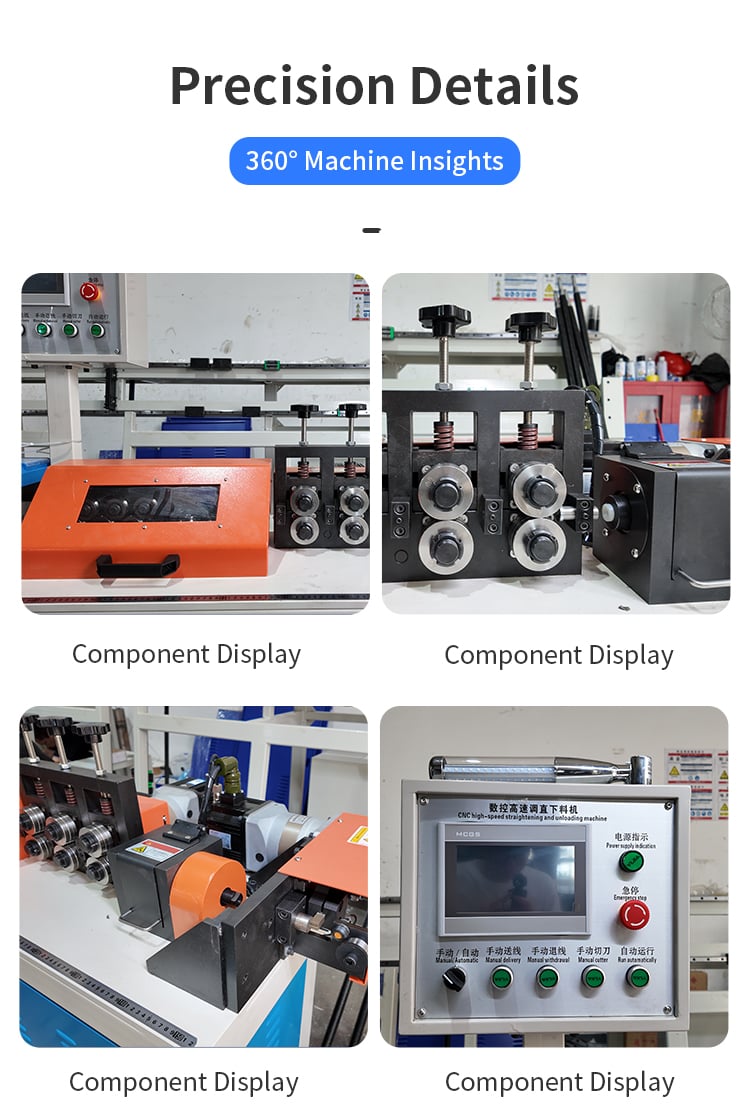
2. Fixed Cut
A fixed cut straightening machine uses a stationary cutting position. The wire is fed to the required length, the line stops or pauses for cutting, and the finished wire is discharged before the next cycle.
Compared with flying shear, the working principle is simpler.
For manufacturers with moderate production volumes or relatively standard cut lengths, this can be a practical and cost-conscious solution. It is often unnecessary to pay for a more complex cutting system when production speed is not the main limitation.
The key question is therefore not:
“Which machine is more advanced?”
It is:
“Does my production actually require continuous high-speed cutting?”
For some factories, the answer is no.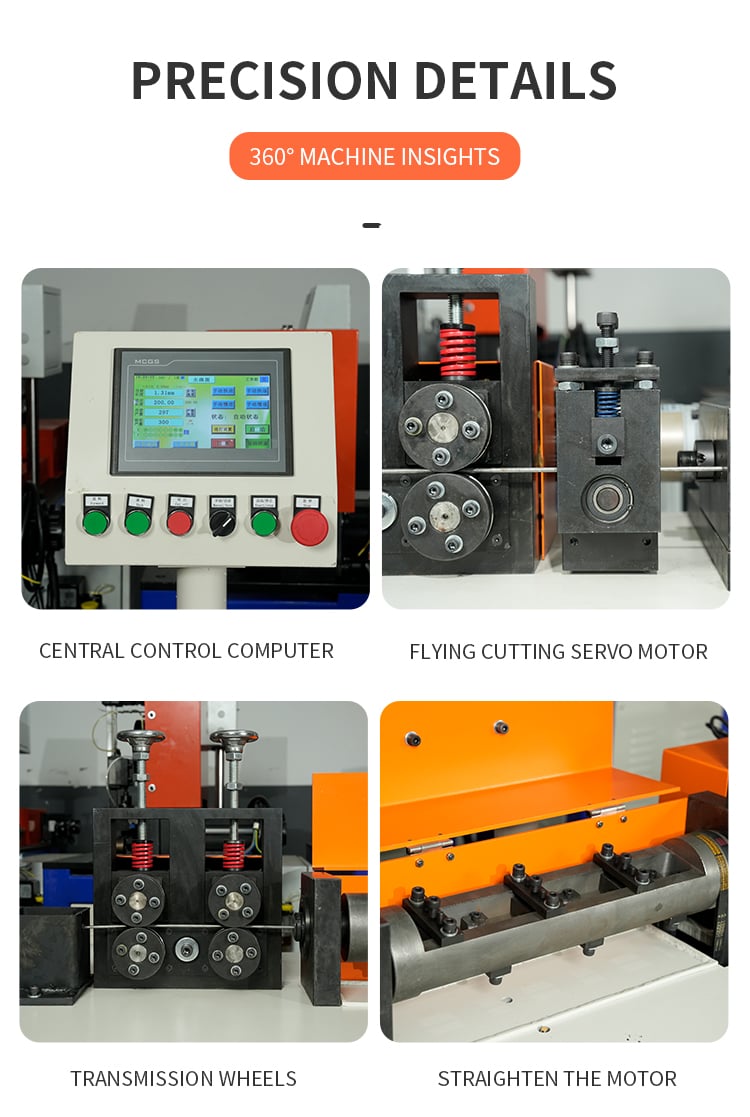
3. Tracking Shear
A tracking shear follows the moving wire during the cutting process instead of relying on a completely stationary cutting position.
This allows the machine to maintain continuous or near-continuous feeding while coordinating the cutter movement with the wire.
The purpose is to find a balance between cutting efficiency and stable continuous production. Jinchun currently offers tracking-shear models for different wire-processing requirements, including configurations listed for wire sizes such as 2–6 mm, 3–8 mm and larger applications.
For buyers who need higher productivity but whose products or material conditions make a simple fixed-cut system less attractive, tracking shear is worth evaluating.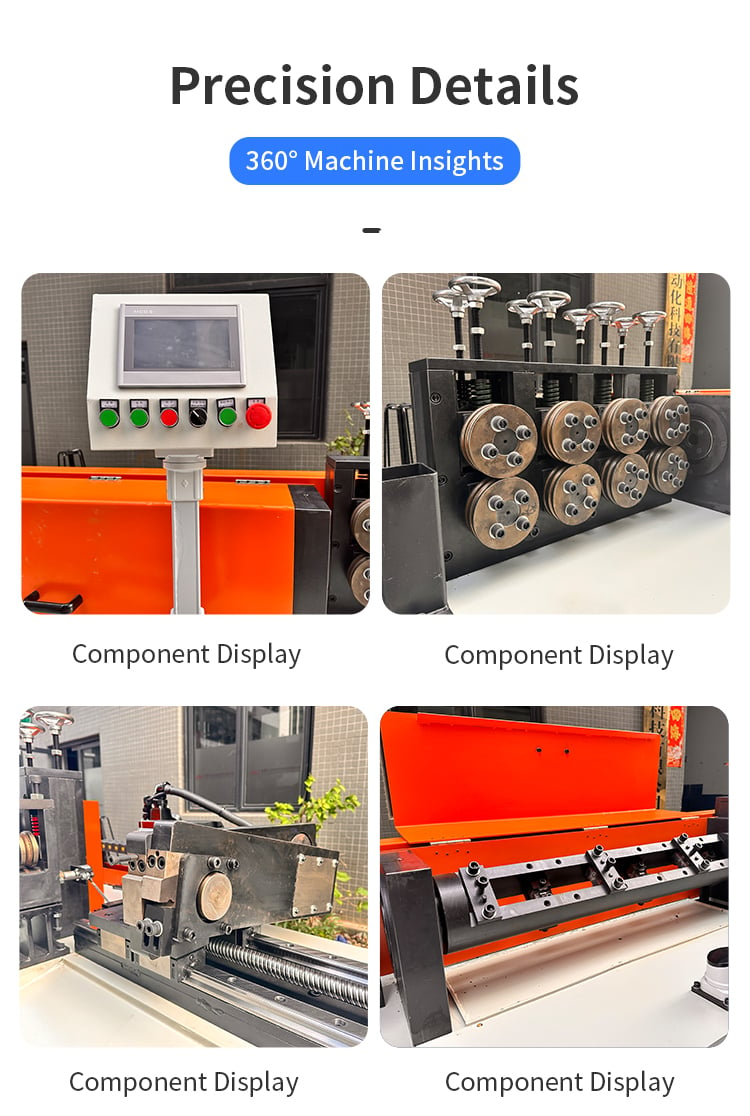
How Does the Cutting Method Affect Line Speed and Stoppage?
For wire straightening production, cutting is often the point where a continuous process is interrupted.
Imagine producing 2-meter straight wires for racks.
A fixed-cut line feeds the wire, reaches 2 meters, stops, cuts, resets and starts again. Every cut introduces a small interruption.
When the number of finished pieces becomes large, those small interruptions accumulate.
Flying shear: designed for continuous production
The major advantage of a wire straightening machine with flying shear is that the cutter can operate while the wire is moving.
This is particularly useful for high-volume orders where machine utilization and line speed matter more than the simplest machine structure.
Jinchun's flying shear product information specifically describes servo-controlled feeding and cutting, with continuous straightening and cutting applications. One listed model is designed for wire up to 16 mm and specifies a continuous straightening speed of 30–40 m/min, depending on the actual production conditions and material.
The important point is not the headline speed alone.
The real value comes from keeping the production cycle stable while minimizing unnecessary stoppage.
Fixed cut: simpler cycle, more interruption
A fixed cut system is naturally more dependent on the cut cycle.
This can still work very well when the required output is moderate, the cut length is standard and there is no strong requirement for uninterrupted feeding.
For many manufacturers, especially those starting automation for the first time, this approach can offer a sensible balance between machine investment and production needs.
Tracking shear: continuous movement with synchronized cutting
Tracking shear works by coordinating the cutting motion with the moving wire.
For factories that want more continuous production without moving directly to the highest-speed configuration, tracking shear may be worth considering.
The correct choice ultimately depends on your target output rather than machine terminology alone.
Cut-Length Accuracy, Surface Quality and Material Suitability
Speed is only one part of the purchasing decision.
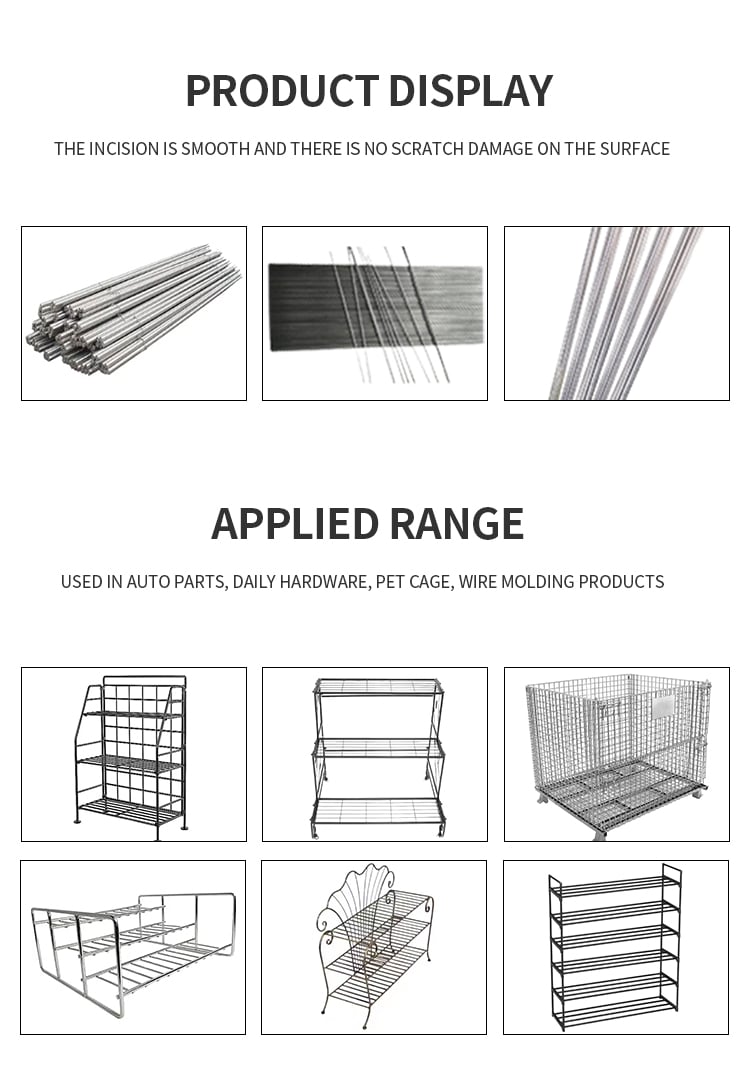
A straightening and cutting machine must also deliver acceptable cut lengths, stable wire straightness and suitable cutting quality for the final product.
Cut-length accuracy
For downstream bending or welding, inconsistent wire length can create bigger problems than a small difference in machine speed.
For example, wire used for:
- shelves
- baskets
- cages
- fan guards
- frame components
- welding assemblies
may later require bending, forming or welding.
If the initial straight wire is inconsistent, the following process may require additional adjustment or create dimensional variation in the finished component.
That is why buyers should define the required cut-length tolerance, not simply state a nominal length.
For example:
Finished wire length: 1,500 mm
Required tolerance: ±1 mm
This gives the machine manufacturer a much clearer engineering target.
Surface quality
Cutting method can also matter when the wire ends become visible or are used directly in later forming and welding processes.
Buyers should evaluate:
- burr formation
- deformation at the cut end
- consistency between batches
- effect of cutting on downstream welding
- whether the wire requires additional chamfering or end processing
Jinchun's product range also includes straightening and chamfering equipment, which can be relevant when wire-end finishing is part of the production process.
Material suitability
Do not choose a cutter based only on diameter.
The same diameter can behave very differently depending on material and mechanical properties.
Typical materials may include:
- carbon steel
- stainless steel
- galvanized wire
- copper
- aluminum
- high-carbon steel
Jinchun's flying shear product range specifically lists steel, stainless steel, copper and aluminum as applicable wire materials, but actual compatibility should always be confirmed against the customer's material grade and production requirements
Which Machine Is Best for Mesh, Racks, Cages and Long Straight Wire?
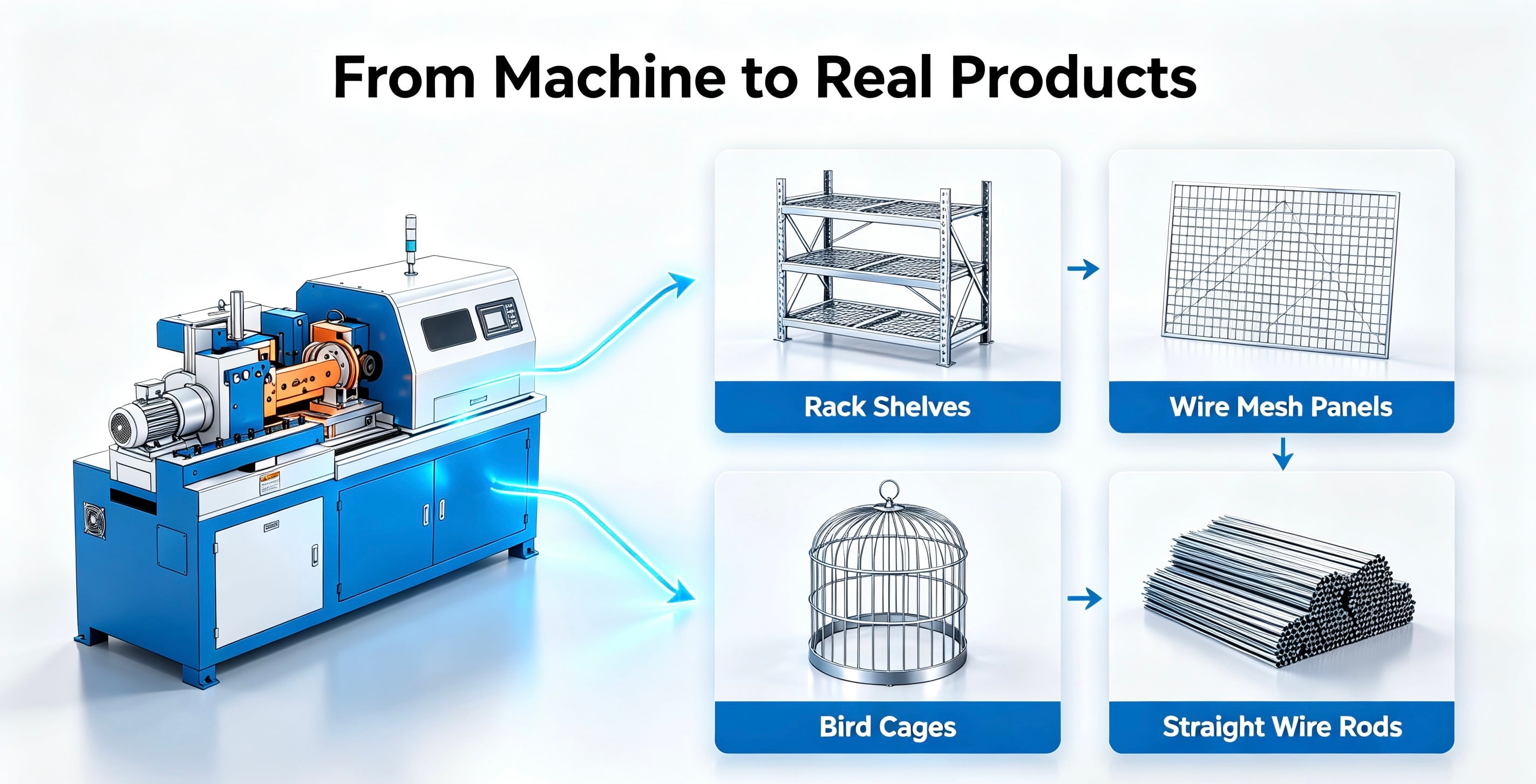
There is no universal winner. Different applications create different priorities.
For mesh and wire grid production
If the wire is continuously straightened and cut before entering a mesh welding or forming process, production volume becomes important.
A flying shear or tracking shear configuration may be more attractive when the line needs high throughput and less interruption.
Jinchun's straightening machine range is also positioned alongside mesh-related welding and production-line solutions, making these configurations suitable for evaluating integrated wire-processing workflows.
For racks and storage products
Rack manufacturers often need large quantities of straight wire for shelves, frame components and support structures.
If the production line runs continuously with high daily output, flying shear can help reduce repeated stopping during cutting.
For lower-volume or mixed production, fixed cut may be sufficient.
For bird cages and pet cages
Cage manufacturers may process multiple wire lengths for vertical bars, horizontal wires and structural components.
Here, the best machine depends heavily on how many different lengths are required.
If there are frequent size changes, the control system, recipe management and changeover process become just as important as the cutting principle itself.
Jinchun lists bird cage and pet cage production lines among its broader wire-production solutions.
For long straight wire
Long straight wire is one of the areas where cutting stability becomes especially important.
When producing longer pieces, any variation in feeding, straightening or cutting can become more noticeable.
For high-volume production of long wire, continuous cutting technologies such as flying shear or tracking shear may deserve closer evaluation.
For moderate output, however, a fixed cut solution can still be technically appropriate.
What Information Should a Buyer Provide Before Requesting a Quote?
One of the biggest mistakes in wire-machine purchasing is asking:
“How much is your wire straightening machine?”
without providing the production requirements.
A professional quotation should be based on the actual application.
1. Wire material
Tell the manufacturer the exact material whenever possible.
For example:
- Mild steel
- Stainless steel 304
- Stainless steel 316
- Galvanized steel
- Copper
- Aluminum
Material grade can affect straightening force, feeding stability and cutting requirements.
2. Exact wire diameter
Do not only say “small wire” or “around 3 mm.”
Provide the actual range, such as:
2.0–3.0 mm
or:
3.2 mm
3. Finished wire length
List both the normal size and the complete size range.
For example:
500 mm / 800 mm / 1,200 mm / 1,500 mm
This helps determine the required feeding and cutting configuration.
4. Length tolerance
This is especially important for customers supplying components to welding or automated bending lines.
Tell the manufacturer whether your tolerance is:
±1 mm
±0.5 mm
or another requirement.
5. Target production
A machine for 5,000 pieces per day is not necessarily the right machine for 50,000 pieces per day.
Tell your supplier:
- pieces per hour
- pieces per day
- shifts per day
- expected future production
This information helps determine whether fixed cut, tracking shear or flying shear is economically justified.
6. Finished-product application
A product photo or drawing can be extremely useful.
For example:
wire for shelves
is less informative than:
3.0 mm galvanized wire, 1,200 mm length, ±1 mm tolerance, 20,000 pcs/day, used for shelf-frame welding
The second description allows an equipment manufacturer to evaluate the complete production requirement.
Machine Trial and Acceptance Checklist
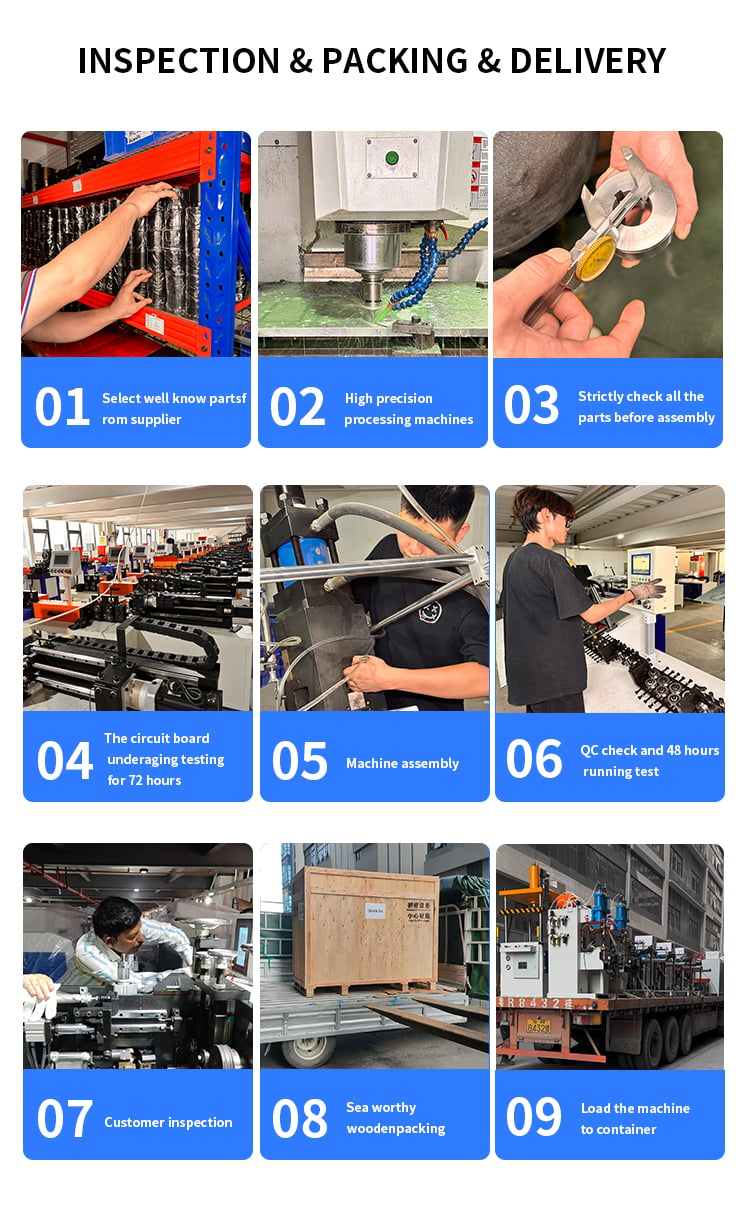
Before purchasing, do not evaluate the machine only by watching an empty machine run.
A proper machine trial should use your actual material.
Test 1: Material compatibility
Run the actual wire grade and diameter that you will use in production.
Test 2: Straightness
Check the finished wire on a flat reference surface or using the measuring method agreed during technical discussions.
Test 3: Cut length
Measure multiple finished pieces rather than checking only one sample.
This helps determine whether the machine maintains stable length accuracy during continuous operation.
Test 4: Cutting end quality
Inspect the wire ends for burrs, deformation and consistency.
This is particularly important when the wire goes directly into bending or welding.
Test 5: Production speed
Do not compare machine speeds without defining the production conditions.
The actual output depends on wire diameter, material, finished length, cutting cycle and machine configuration.
Test 6: Changeover
Ask how easily operators can switch between different wire diameters and cut lengths.
For factories producing multiple products, changeover time can have a major impact on total productivity.
Test 7: Acceptance standards
Before placing the order, define measurable acceptance criteria:
- material
- wire diameter
- wire length
- length tolerance
- straightness requirement
- cutting quality
- target output
- continuous running time
This creates a clearer basis for machine acceptance and avoids misunderstandings after delivery.
How Should You Choose Between Flying Shear, Fixed Cut and Tracking Shear?
A simple way to think about the three solutions is:
| Requirement | Recommended Direction |
|---|---|
| Moderate output, simple cutting cycle | Fixed Cut |
| Higher productivity with synchronized cutting | Tracking Shear |
| High-volume continuous production | Flying Shear |
| Many wire materials | Confirm material-specific configuration |
| Multiple finished lengths | Prioritize control and changeover |
| Strict downstream dimensional requirements | Confirm cut-length tolerance through trial |
The most important point is that a more advanced cutting system is not automatically a better investment.
The correct machine is the one that matches your actual production volume, wire properties, finished dimensions and downstream process.
Conclusion: Choose the Wire Straightening Machine Around Your Production, Not Just the Cutter
A wire straightening machine with flying shear is a strong option when continuous high-volume production and reduced cutting interruption are priorities. A fixed cut straightening machine can be a practical choice for simpler, moderate-volume production, while a tracking shear straightening machine offers another solution for manufacturers looking for synchronized cutting with continuous wire movement.
Jinchun's product range includes all three configurations, allowing the machine selection to be matched to different wire-processing requirements.
Before requesting a quotation, send us your product drawing or photo, wire material, exact wire diameter, finished length, required dimensional tolerance and target production volume.
With these details, Jinchun can evaluate your application and recommend the appropriate wire straightening and cutting machine rather than simply offering a standard machine model.
Table of Contents
- What Do Flying Shear, Fixed Cut and Tracking Shear Mean?
- How Does the Cutting Method Affect Line Speed and Stoppage?
- Cut-Length Accuracy, Surface Quality and Material Suitability
- Which Machine Is Best for Mesh, Racks, Cages and Long Straight Wire?
- What Information Should a Buyer Provide Before Requesting a Quote?
- Machine Trial and Acceptance Checklist
- How Should You Choose Between Flying Shear, Fixed Cut and Tracking Shear?
- Conclusion: Choose the Wire Straightening Machine Around Your Production, Not Just the Cutter