 EN
EN


In the modern manufacturing landscape, the drive for efficiency often leads facilities to re-evaluate their core machinery. Many workshops struggle with manual processes that are slow, prone to human error, and difficult to scale. This case study explores how the integration of an automated Bending Machine can transform production outputs, specifically highlighting how different configurations of wire bending technology can increase production speeds by as much as 40% while maintaining unmatched precision. By transitioning from manual jigs to CNC-controlled systems, manufacturers in the automotive, furniture, and hardware sectors are achieving significant competitive advantages.
The Impact of 2D Wire Bending on High-Volume Output
For facilities focused on planar components, the 2D Wire Bending Machine serves as the primary driver for rapid scaling. These machines are designed to handle iron, stainless steel wires and flat bars with diameters ranging from 1mm to 8mm. The shift to automation allows for the production of 15 to 45 2D parts per minute, reaching a precision level of 0.05mm. This speed is largely attributed to the use of universal tooling, which minimizes downtime by allowing the machine to adapt to different shapes without the need for constant tool replacements.
Operational efficiency is further enhanced by the software integration of these 2D systems. New operators can master the multilingual touch and button control interface in just 60 minutes, drastically reducing training costs. The system supports CAD one-key import for instant program generation and can store up to 10,000 unique programs. For industries such as automotive parts, shelving, and livestock equipment, the ability to add optional modules for welding, punching, or stamping directly into the bending cycle creates a comprehensive production cell that eliminates secondary handling.
Precision Multi-Angle Forming with 3D Wire-Rotating Systems
When a project moves beyond flat shapes into complex 3D geometries, the 3D Wire Bending Machine (Wire-Rotating) becomes essential. This configuration is primarily designed for smaller-volume, high-precision 3D products. It utilizes a specialized gearbox to synchronously rotate the product, enabling multi-angle forming from a single feed. This mechanical advantage allows for a production rate of 15 to 30 3D pieces per minute, ensuring that even complex items like decorative crafts and fasteners are produced quickly.
The versatility of the wire-rotating system is found in its configurable axis counts, which can range from 3 to 9 axes depending on the complexity of the product. Despite this technical sophistication, the barrier to entry remains low; beginners can become proficient with the intuitive multilingual UI in approximately two hours. With a build quality that guarantees an average lifespan of over 15 years and an annual failure rate of less than 2%, this machine provides a stable, long-term solution for high-precision furniture and motorcycle part manufacturing.
Advanced Large-Scale Production with Head-Rotating 3D Technology
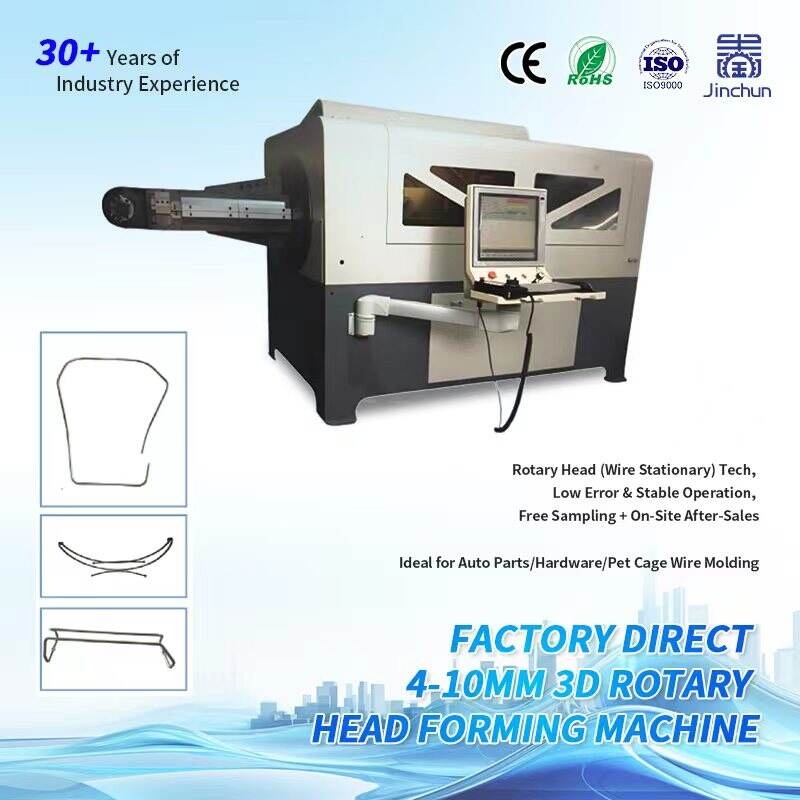
For larger 3D precision products, such as automotive seat frames, the 3D Wire Bending Machine (Head-Rotating) offers a different mechanical approach to boost speed. Instead of rotating the wire, this machine utilizes a rotating arm to perform multi-angle forming around the material. This "head-rotating" principle is vital for maintaining a high precision of 0.01mm on larger frames that would be too cumbersome to rotate physically. Like the wire-rotating variant, it creates 15 to 30 3D parts per minute and handles materials up to 8mm in diameter.
These machines are highly customizable, with axis configurations typically ranging from 3 to 9 axes to accommodate rapid production of complex automotive and gardening equipment. The head-rotating system also eliminates the need for tool replacements during setup changes, allowing for a continuous workflow. With a robust construction and an average after-sales response time of less than two hours, these machines ensure that industrial facilities can maintain the 40% speed increase consistently over a 15-year service life.
Technical Comparison of Automated Wire Bending Solutions
Choosing the correct machine depends on the specific geometry and volume of the parts being produced. The following table provides a technical breakdown of the three primary bending solutions available for industrial applications.
Feature |
2D Wire Bending Machine |
3D Wire-Rotating Machine |
3D Head-Rotating Machine |
Material Compatibility |
Iron, SS(Round/Flat) |
Iron, SS (Round/Flat) |
Iron, SS(Round/Flat) |
Max Wire Diameter |
8mm |
8mm |
8mm |
Production Speed |
15–45 pcs/min |
15–30 pcs/min |
15–30 pcs/min |
Precision |
0.05mm |
0.01mm |
0.01mm |
Learning Curve |
1 Hour |
2 Hours |
2 Hours |
Axes Customization |
Standard |
3–9 Axes |
3–9 Axes |
Storage Capacity |
10,000 Programs |
10,000 Programs |
10,000 Programs |
Average Lifespan |
10+ Years |
15+ Years |
15+ Years |
Warranty |
2 Years |
2 Years |
2 Years |
Quality Standards and Global Reliability
All modern automated bending equipment must meet international standards to ensure safety and reliability in a high-speed production environment. Every machine in this series undergoes strict quality control (QC) testing before leaving the factory and holds CE certification. This ensures that the components, from the multilingual touch screens to the high-pressure gearbox systems, can withstand the rigors of 24/7 industrial use.
Furthermore, the commitment to long-term performance is reflected in the comprehensive support packages provided with these machines. A standard 2-year warranty covers all configurations, providing peace of mind for the initial investment. With an average after-sales service response time of less than two hours, manufacturers can rely on a support network that understands the critical nature of keeping a production line active. This combination of durable builds and rapid support is what allows facilities to maintain their increased production speeds year after year.
Frequently Asked Questions (FAQ)
Which machine is best for manufacturing car seat frames?
The 3D Wire Bending Machine (Head-Rotating) is specifically designed for larger precision products like automotive seat frames. Its rotating arm allows for multi-angle forming without the need to rotate large, heavy wire structures, maintaining high precision.
Can these machines handle both round and flat materials?
Yes, all three machine types (2D, 3D Wire-Rotating, and 3D Head-Rotating) are capable of processing round wire and flat bar materials made of iron, stainless steel. They only require a simple mold change to switch between different material types.
How difficult is it for a new employee to operate a 2D Bending Machine?
The learning curve is very low. Thanks to the multilingual touch and button intelligent system, a new operator can master the 2D machine within approximately one hour. The 3D models typically take only two hours for a beginner to become proficient.
What are the optional functions available for these machines?
Manufacturers can choose to integrate customized functions such as welding, punching, or stamping directly into the machine's workflow. This allows for a more streamlined production process where parts are formed and finished in a single operation.
What is the expected durability of these machines in a factory setting?
The 2D models have an average service life exceeding 10 years, while both 3D configurations are built to last over 15 years. The annual failure rate for these machines is consistently low, ranging between 2% and 3%.
Table of Contents
- The Impact of 2D Wire Bending on High-Volume Output
- Precision Multi-Angle Forming with 3D Wire-Rotating Systems
- Advanced Large-Scale Production with Head-Rotating 3D Technology
- Technical Comparison of Automated Wire Bending Solutions
- Quality Standards and Global Reliability
- Frequently Asked Questions (FAQ)