 EN
EN


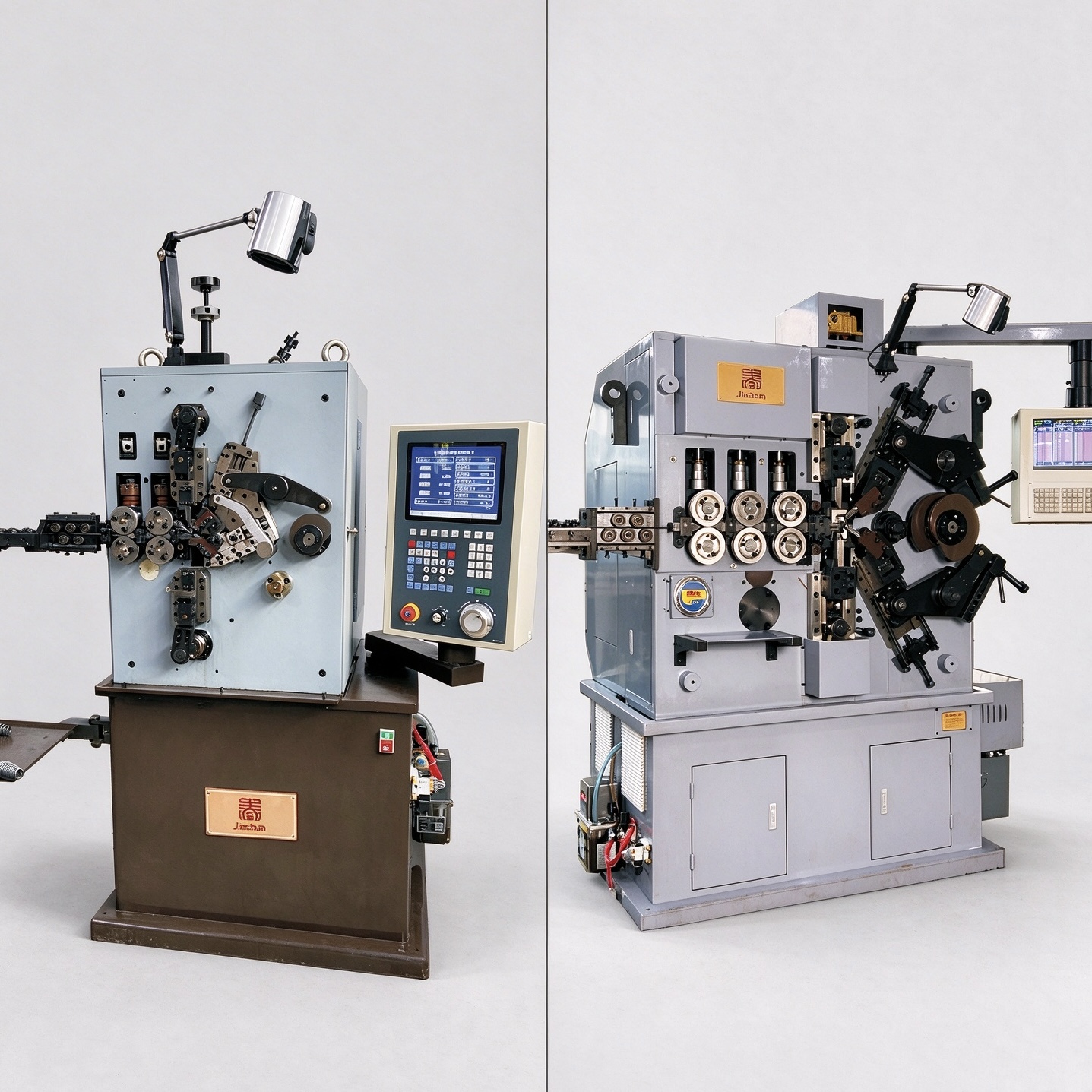
Introduction
Choosing between a four-axis and five-axis CNC compression spring machine should not begin with the assumption that more axes automatically mean a better machine. The correct choice depends on the movements required by the spring, the wire properties, the forming sequence, the production volume, and the level of flexibility expected from the equipment. A manufacturer producing a stable family of conventional compression springs may value efficient setup and repeatability, while a plant handling variable-pitch or shaped springs may need more independent motion control.spring making machine
selection should therefore start from the finished spring drawing and process requirements. The number of controlled axes is only meaningful when those axes are matched to real forming tasks.
1. What the Controlled Axes Do
On a CNC compression spring machine, coordinated axes manage the movements needed to turn straight wire into a controlled helical shape. Depending on the machine configuration, these movements can include wire feeding, coil-diameter forming, pitch control, cutting, and auxiliary forming actions. The exact assignment of each axis should always be confirmed for the selected model rather than inferred from the axis count alone.
Wire feeding determines how much material enters the forming zone and strongly influences coil count and free length. Diameter-forming movements establish the coil profile. Pitch control determines the spacing between active coils and may need to change during the same spring. Cutting separates the finished spring cleanly after the programmed sequence. When a spring requires additional or more independently controlled movements, the available axis architecture becomes more important.
2. When a 4-Axis Machine Is a Good Fit
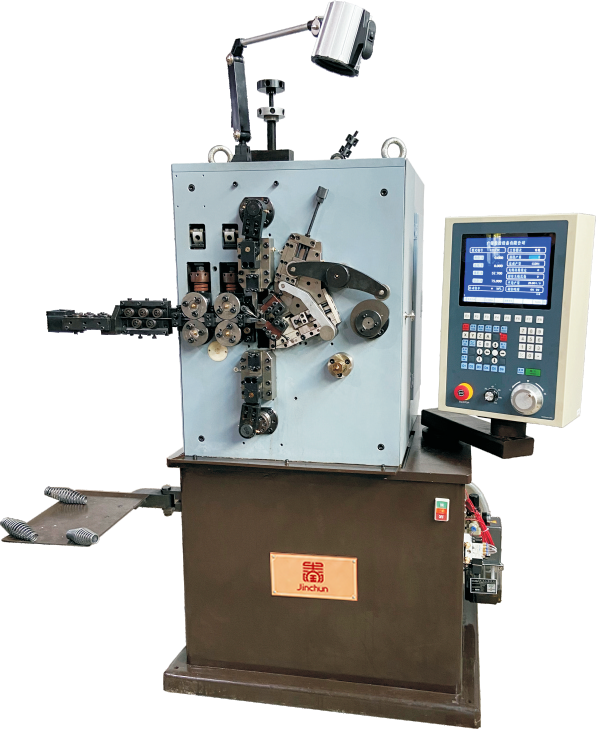
A four-axis configuration is often a practical choice for manufacturers producing conventional compression springs with stable specifications. Typical projects include cylindrical springs and compatible tapered or variable-pitch designs that can be completed within the machine's configured motion sequence.4-axis CNC spring coiling machine
is especially relevant when repeat orders, efficient parameter adjustment, and consistent batch production are priorities. Stored programs can reduce setup work for recurring products, while replaceable tooling supports compatible specification changes.
For a production line with a limited number of mature spring designs, the advantage of a four-axis machine is not simply lower complexity. It is the ability to use the required motions without paying for or managing control functions that the product does not need. The final decision should still consider wire diameter, tensile strength, coil ratio, end configuration, cutting requirements, tolerances, and target output.
3. When a 5-Axis Machine Adds Value
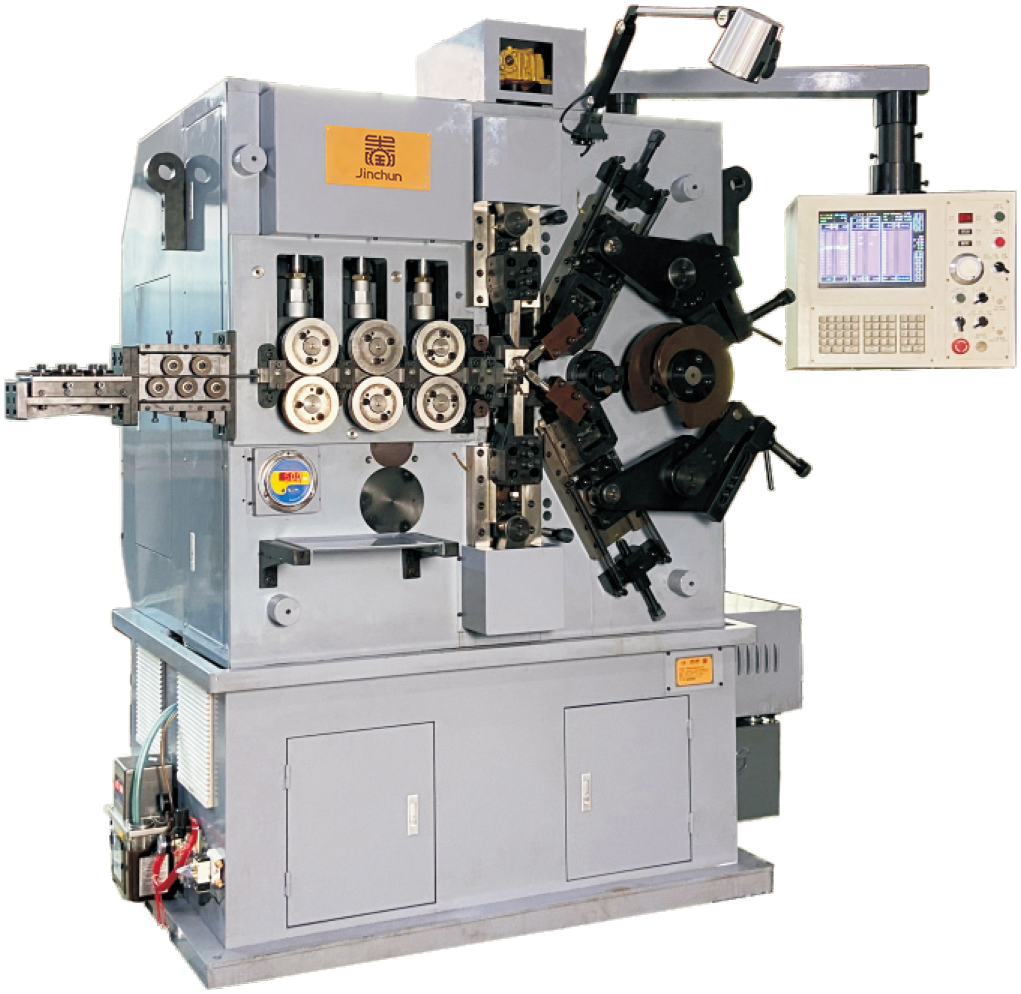
A five-axis machine becomes more valuable when the spring design benefits from an additional independently coordinated movement. This may apply to more demanding pitch patterns, shaped compression springs, larger or stronger wire within a suitable machine range, or production families that require broader adjustment between products.5-axis CNC compression spring machine
provides programmable control for compatible coil diameter, pitch, coil count, spring length, and forming sequences. The added flexibility can be useful when constant-pitch and variable-pitch products share the same production environment or when the plant expects its spring range to expand.
However, a fifth axis should solve a defined forming requirement. If the spring geometry can already be produced reliably on a four-axis configuration, an extra axis does not automatically improve the finished spring. Machine selection should remain process-driven.
4. Spring Geometry and Wire Properties
Spring geometry is one of the strongest factors in machine selection. Important dimensions include wire diameter, inside or outside coil diameter, free height, total coils, active coils, pitch distribution, winding direction, and end-coil configuration. Cylindrical, conical, barrel-shaped, hourglass-shaped, and variable-pitch springs can impose different movement and tooling requirements.
Wire properties are equally important. Carbon spring steel, stainless steel, alloy spring wire, and other formable materials behave differently because tensile strength, surface condition, hardness, and springback affect forming load and dimensional recovery. Two springs with the same nominal wire diameter may therefore require different machine capacity or setup if their materials differ substantially.
Load requirements should also be supplied when they are part of the product specification. A spring that must deliver a defined load at a specified compressed height cannot be evaluated only by appearance and dimensions.
5. Tooling, Setup and Program Changeover
Tooling converts programmed machine motion into the actual spring shape. Coiling points, guides, pitch tools, cutters, and other forming elements must match the wire and finished geometry. Tooling condition and alignment directly influence surface quality, coil consistency, and dimensional repeatability.
For repeat orders, stored production programs are useful because the operator can recover a proven parameter set and then verify it through sample production. A stored program does not eliminate setup checks: wire batch, tooling wear, lubrication, and material springback can still require fine adjustment.
When product changeovers are frequent, evaluate the complete changeover process: tooling replacement, guide adjustment, program loading, sample verification, dimensional inspection, and approval. The best machine is the one that makes this routine predictable for the actual product mix.
6. Output and Quality Comparison
Production speed should be evaluated together with quality. A high nominal speed has little value if the spring requires frequent adjustment or if the process produces unstable free length, coil diameter, pitch, or end geometry. Actual output depends on material, wire size, spring dimensions, forming complexity, cutting method, and tolerance requirements.
For both four-axis and five-axis machines, quality evaluation should include consecutive samples rather than a single good part. Check outside or inside diameter, free length, pitch distribution, coil count, end position, and any specified load value. For demanding applications, process capability should be confirmed under realistic production conditions.
A five-axis machine may offer more flexibility for complex sequences, while a four-axis machine may be highly efficient for a stable product family. Neither architecture should be judged by axis count alone.
7. Decision Table
Production situation |
4-axis configuration |
5-axis configuration |
Conventional compression springs with stable geometry |
Strong fit when required motions are covered |
Possible, but extra control may not be necessary |
Frequent repeat orders |
Good fit with stored programs and proven tooling |
Good fit, especially if product family is broader |
Variable pitch / shaped profiles |
Suitable when within confirmed configuration |
Often preferred when added independent control is useful |
High product variety |
Suitable for compatible product range |
More flexibility for varied forming requirements |
Large or demanding springs |
Depends on model capacity and wire properties |
Heavy-duty 5-axis models may be evaluated where applicable |
Selection priority |
Efficient, sufficient motion control |
Additional independent motion where the product requires it |
8. Information Needed Before Quotation
To recommend the correct machine, provide the finished spring drawing or a physical sample, wire material and diameter, tensile strength if known, spring inside or outside diameter, free length, total and active coil quantities, pitch or pitch distribution, winding direction, end-coil configuration, dimensional tolerances, and any load requirement.
Also state the expected production volume, batch size, number of different spring specifications, and how often changeovers are expected. This information allows the machine, tooling, cutting method, and control configuration to be evaluated as one production solution rather than as isolated specifications.
Conclusion
The right axis count is the one that matches the actual spring movements. A four-axis machine can be an efficient and repeatable solution for many conventional compression springs, while a five-axis machine can add value when the product requires greater motion independence, broader geometry flexibility, or more demanding production conditions. Start with the drawing, material, tolerances, load, and output target; then assign the required machine functions.
For a model and tooling recommendation based on your spring drawing, contact Jinchun
with your product specifications and target capacity.